

This article appears in Pre Shift, our newsletter for bartenders and the hospitality industry. Subscribe for more stories like this in your inbox.
To someone who’s never bartended, Josh Seaburg’s Spinzall tattoo might easily be mistaken for a food processor. But to Seaburg, the tattoo, which has the words “All I Do Is Spin” emblazoned in block letters across his right calf, is a testament not only to his love of bartending but also his affection for Dave Arnold’s groundbreaking desktop centrifuge, which he’s owned since its inception. “Instead of bringing in a photo of it for my tattoo artist, I brought the actual Spinzall into the shop,” he says.
Seaburg manages two cocktail bars in Norfolk, Virginia, and was among the earliest adopters of the Spinzall. As the tattoo suggests, he remains a persistent evangelist for the device’s utility behind the bar, having originally purchased one through Arnold’s Kickstarter campaign, which launched 10 years ago this month, for the promotional price of $699. (Upon official release, the Spinzall retailed for $999.) “I’d already been following Dave’s Cooking Issues blog and listening to his podcast for years,” says Seaburg, “so by the time the Spinzall hit my bar, I was already pretty well-versed in all of the ins and outs of clarification.”
Josh Seaburg’s Spinzall tattoo.
Over the past decade, trends in the bar industry have come and gone, but the Spinzall has remained a stalwart in the prep kitchens of top bars around the world. More so than perhaps any other bar-centric innovation, it continues to influence how a generation of modern bartenders approaches making cocktails.
Long before Arnold opened his first bar Booker and Dax in 2012, he’d already been experimenting with commercial-grade centrifuges. As the director of culinary technology at the French Culinary Institute in New York City in the early 2000s, Arnold spent thousands of hours testing equipment, including rotary evaporators and immersion circulators, to gauge their utility for chefs. At the time, he was obsessed with clarifying lime juice to perfect the Gin & Tonic.
“Back then, there were a handful of chefs using centrifuges in Spain, but no one was really using them here in the U.S,” he says. “So, when Unilever donated a super-speed centrifuge the size of a washing machine to the institute, lime juice was one of the first things I tested on it.” To force-carbonate the combined ingredients in a proper G&T, he had determined that the lime juice needed to be crystal clear. But popular clarification techniques at the time, such as using agar agar or the freeze-thaw method, weren’t effective with lime juice, which has a low pH and oxidizes quickly.
Arnold eventually perfected a method for clarifying lime juice in a centrifuge using enzymes and wine fining agents, which he wrote about at length in his seminal 2014 book Liquid Intelligence. But the technology wasn’t readily available to most bars because commercial centrifuges were prohibitively expensive—laboratory-grade models could cost upwards of $60,000.
“I realized that if you build a bar program around something that you can only afford to have one of and it breaks, you’re toast,” says Arnold. “So, I thought, what the bar community needed was something small and cheap enough that they could have several of them. They needed to be portable, safe and able to deliver the same results as a $10,000 bench-top machine, without the need for advanced training or expertise.”
The Spinzall’s journey from concept and design to production took years. Recruiting a manufacturing partner was one of the biggest initial hurdles. “No one had ever made a centrifuge for anything other than medical purposes before, so when we approached our agent in China, they didn’t understand why anyone would want to buy one,” Arnold says.
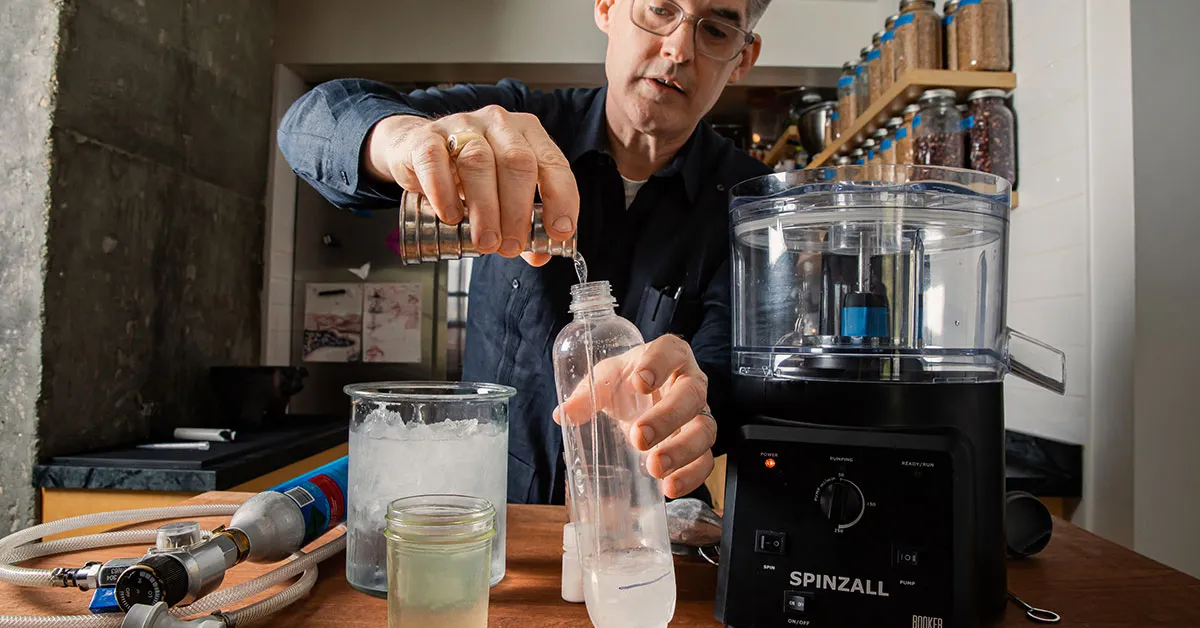
Eventually, the factory in China that collaborated with him on the Searzall, a handheld broiler he invented years earlier, agreed to manufacture the Spinzall. The custom-designed machine generates around 2,000 g-units of centrifugal force—faster than a benchtop centrifuge due to its smaller diameter—which separates liquids from solids in an open-bucket rotor. Unlike more expensive lab-grade models that require precise weighing and balancing and can only be run in intervals, the Spinzall has a continuous mode, allowing bartenders to clarify large batches without interruption.
Early adopters of the Spinzall recognized that it was vastly superior to other analog clarification methods. By clarifying liquids faster, continuously and without evaporation, the device saved time without stripping away key flavor components, the way that milk-washing or manual filtration often do.
The product didn’t take off overnight, but its launch was a pivotal moment; bartenders were learning to embrace a more scientific approach to R&D and cocktail construction. “I think the Spinzall shifted the attention of the industry,” says Ryan Chetiyawardana, co-owner of five award-winning bars, including London’s Seed Library and Silver Lyan in Washington, D.C. “It was a big statement for bartenders that we could have something that was built specifically for us.”
The Spinzall’s most ardent fans continue to use it in their daily practice. Four years before opening his first bar Thunderbolt in Los Angeles, Mike Capoferri preordered two Spinzalls during the initial Kickstarter run, knowing that his bar program would rely heavily on clarification; today he owns 17 of them. Signature drinks like the Liquid Picnic, a savory Martini made with clarified tomato water, require daily prep on the Spinzall. “We still make the tomato water in the Spinzall the same way we did when we opened seven years ago,” says Capoferri.
The Spinzall enables bars to make clarified cocktails like Thunderbolt’s Liquid Picnic at scale.
Arnold credits the growing trend of clarified cocktails for fueling sustained interest in his creation. “All of a sudden after the pandemic, these techniques that I had been pushing for years became a lot more popular,” he says. Even established international bar programs are discovering the device for the first time. “We just acquired a Spinzall at the start of this year,” says Tom Egerton, co-founder of Tokyo Confidential in Tokyo. He and his team had been using manual clarification methods, but eventually invested in a Spinzall to save time and space. “It’s a tool that supports the operational reality of the bar as it grows.”
At Dokidoki in Brooklyn, which opened in July, the team uses a Spinzall to infuse shochu with a sweet potato koji mixture as the base for the Chucu-Chucu, a Margarita variation. For the Coastline Chronicles, an Old-Fashioned riff made with a blend of aged sakes, plantain syrup is also clarified in the centrifuge. “We wouldn’t be able to serve these drinks if not for the Spinzall because we are incorporating starchy ingredients that would otherwise separate and look murky in the cocktail,” says co-owner A-K Hada.
Arnold says that while Spinzall sales have remained healthy in recent years, the pandemic caused supply chain disruptions that led the product to be out of stock for over a year. “Our manufacturer in China closed down. The factory was sold and then resold, and in the process of reselling, they lost their ability to make it. We finally got them to be able to make it again, but the price was much higher,” he says.
Modernist Pantry, a longtime collaborator with Arnold, is now Spinzall’s exclusive retail partner, offering a new 2.1 version of the product with upgraded continuous mode and a mechanical lid interlock system for increased safety. In February 2024, the company announced it was raising the price to $1,199 from $999, citing rising tariffs and increased production costs. Low-cost benchtop centrifuges on sites like Alibaba and Ali Express are still the Spinzall’s primary competition; for now, an outstanding patent protects it from duping. “If I could get someone to make it more cheaply, I would license it to them,” says Arnold. “My goal has always been to get more people to use it.”
For those already indoctrinated, the only drawback to the Spinzall’s growing popularity is that bartenders are often a little too eager to use it. “A lot of bartenders feel like they bought this new expensive toy, so they feel like they need to clarify every drink on their menu,” says Seaburg. “But even after all this time, whenever I see a Spinzall on the backbar, I’m inclined to think that this bar knows game.”
Get our freshest features and recipes weekly.
Related Articles
More Stories you may like