

This post may contain affiliate links. Read my full disclosure policy.
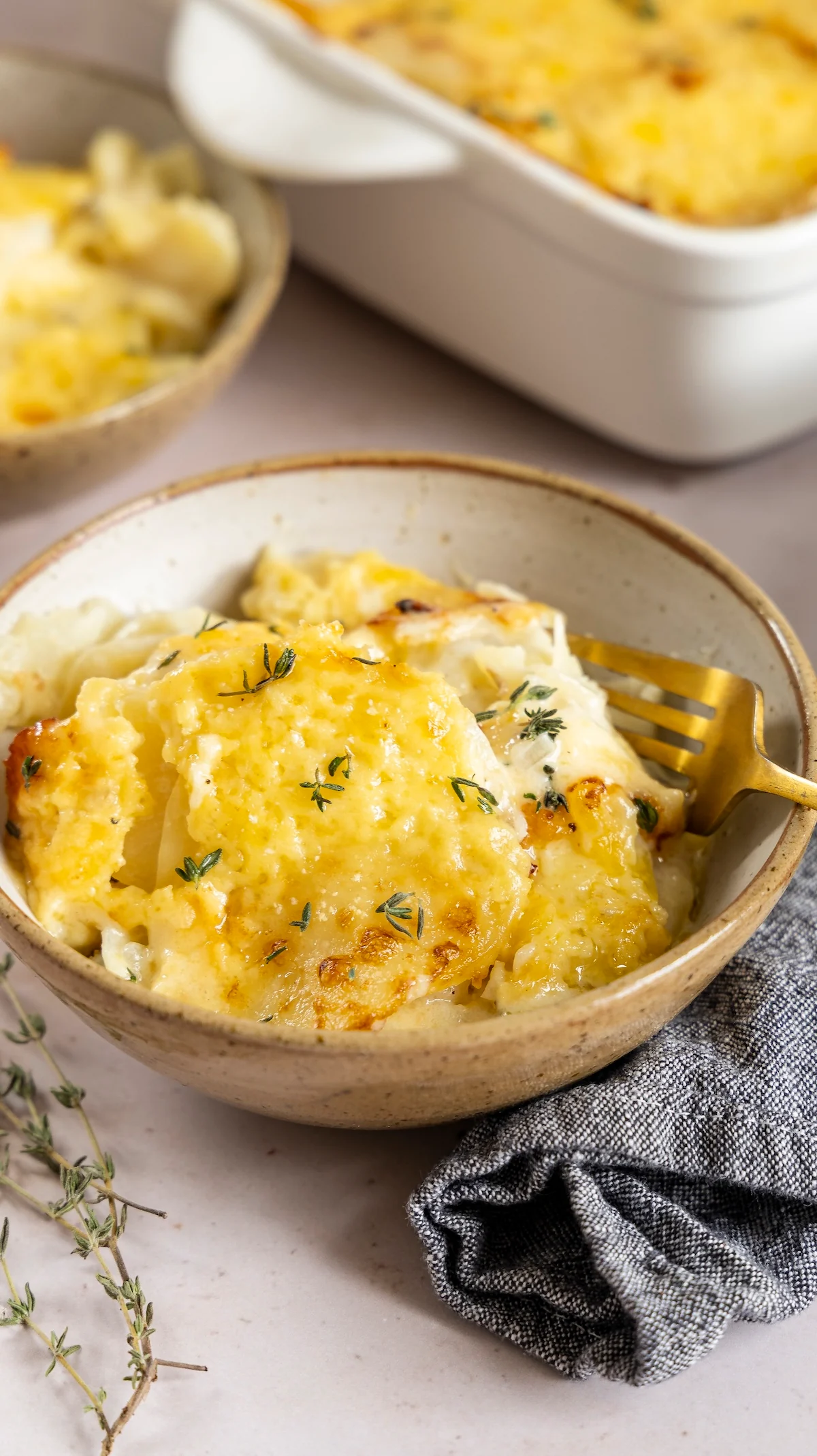
With layers of tender potatoes in a rich, creamy sauce and plenty of sharp cheddar on top, this scalloped potatoes recipe is comfort food at its best.
The trick to making really good scalloped potatoes is to give them a head start on the stovetop. In this recipe, adapted from America’s Test Kitchen, thinly sliced potatoes simmer in milk and cream until they’re almost tender, then finish cooking in the oven under a layer of sharp cheddar. As the potatoes simmer, they release their starch, which thickens the sauce naturally—no flour needed. The result is tender potatoes in a rich, creamy sauce with a golden, bubbly cheese topping.
These scalloped potatoes are perfect alongside glazed ham or Thanksgiving turkey, but they’re just as good with a simple roast chicken. And here’s a bonus, especially around the holidays: you can do most of the work a day ahead, then just add the cheese and bake before serving.
Scalloped Potatoes vs. Potatoes au Gratin
What’s the difference between scalloped potatoes and potatoes au gratin? Traditionally, scalloped potatoes are baked in a creamy sauce without cheese, while potatoes au gratin have a golden, cheesy topping. These days, though, the lines are pretty blurry, and you’ll find plenty of cheesy scalloped potato recipes, including this one!
My potatoes au gratin are a little different: they’re made with heavy cream and Parmesan layered between the potatoes, then baked until tender and golden. Both are delicious, but these scalloped potatoes have one big advantage: you can do most of the work a day ahead, then just add the cheese and bake before serving.
What You’ll Need To Make Scalloped Potatoes
- Butter, Onion & Garlic: Create a flavorful base for the sauce. The onion cooks until soft and sweet, while the garlic adds depth without overpowering the potatoes.
- Russet Potatoes: Their high starch content helps thicken the sauce as the potatoes cook. Don’t rinse them after slicing, or you’ll wash away that useful starch.
- Milk & Heavy Cream: Combine to make a rich, creamy sauce without making the dish too heavy.
- Fresh Thyme: Adds a subtle herbal note that pairs well with the potatoes and cheddar. Dried thyme works, too.
- Sharp Cheddar Cheese: Melts into a golden, bubbly topping and adds a nice sharpness to balance the mild potatoes and cream.
- Jump to the printable recipe for precise measurements
How To Make Scalloped Potatoes
Make-Ahead, Storage & Reheating
To make ahead, simmer the potatoes as directed, transfer to the baking dish, and spread into an even layer. Let cool, then cover and refrigerate for up to 1 day. When ready to serve, let stand at room temperature for 30 minutes, sprinkle with the cheddar, and bake at 425°F until hot, bubbly, and golden, 20 to 25 minutes. Let rest for 10 minutes before serving.
Store leftovers in an airtight container in the refrigerator for up to 3 days. Reheat, covered with foil, in a 350°F oven for 20 to 25 minutes, or microwave individual portions. Add a splash of milk or cream if the sauce is too thick.
Scalloped Potatoes
Adapted from America’s Test Kitchen
Tender potatoes in a rich, creamy sauce topped with golden, bubbly cheddar make this classic side dish perfect for holidays and Sunday dinners.
Servings: 4 to 6
Prep Time: 20 minutes
Cook Time: 35 minutes
Total Time: 55 minutes
Ingredients
US CustomaryMetric
- 2 tablespoons unsalted butter
- 1 medium yellow onion, finely chopped
- 2 cloves garlic, minced
- 2½ lb russet potatoes, peeled and sliced ⅛-in (3-mm) thick (see note)
- ¾ cup milk (whole or low-fat)
- 1¼ cups heavy cream
- 1 tablespoon chopped fresh thyme leaves (or 1 teaspoon dried)
- 1½ teaspoons salt
- ¼ teaspoon freshly ground black pepper
- 2 cups (8 oz) shredded sharp cheddar cheese
Instructions
-
Preheat the oven to 425°F (220°C) and set an oven rack in the middle position.
-
Melt the butter in a large pot over medium heat. Add the onion and cook, stirring occasionally, until softened, about 5 minutes.
-
Stir in the garlic and cook until fragrant, about 30 seconds. Do not brown. Add the potatoes, milk, heavy cream, thyme, salt, and pepper, and bring to a simmer.
-
Cover, reduce the heat to medium-low, and simmer until the potatoes are almost tender (a paring knife should slide into a potato slice with slight resistance), 10 to 13 minutes, stirring once or twice during cooking to prevent the potatoes from sticking.
-
Transfer the mixture to an 8-in (20-cm) square baking dish and spread into an even layer. Sprinkle evenly with the cheddar cheese.
-
Bake until the sauce is bubbling around the edges and the top is golden brown, 15 to 20 minutes.
-
Let cool for 10 minutes before serving.
Notes
Use a mandoline to slice the potatoes ⅛-inch thick, or a sharp knife to cut them into thin, even slices. If using a knife, cut a thin slice off one side of each potato first so it sits flat on the cutting board for easier, safer slicing. Don’t rinse the potatoes after slicing; their starch helps thicken the sauce.
Nutrition Information
Per serving (6 servings) Calories: 527kcalCarbohydrates: 41gProtein: 16gFat: 35gSaturated Fat: 21gCholesterol: 105mgSodium: 771mgFiber: 3gSugar: 5g
This website is written and produced for informational purposes only. I am not a certified nutritionist and the nutritional data on this site has not been evaluated or approved by a nutritionist or the Food and Drug Administration. Nutritional information is offered as a courtesy and should not be construed as a guarantee. The data is calculated through an online nutritional calculator, Edamam.com. Although I do my best to provide accurate nutritional information, these figures should be considered estimates only. Varying factors such as product types or brands purchased, natural fluctuations in fresh produce, and the way ingredients are processed change the effective nutritional information in any given recipe. Furthermore, different online calculators provide different results depending on their own nutrition fact sources and algorithms. To obtain the most accurate nutritional information in a given recipe, you should calculate the nutritional information with the actual ingredients used in your recipe, using your preferred nutrition calculator.
Gluten-Free Adaptable Note
To the best of my knowledge, all of the ingredients used in this recipe are gluten-free or widely available in gluten-free versions. There is hidden gluten in many foods; if you’re following a gluten-free diet or cooking for someone with gluten allergies, always read the labels of your ingredients to verify that they are gluten-free.