

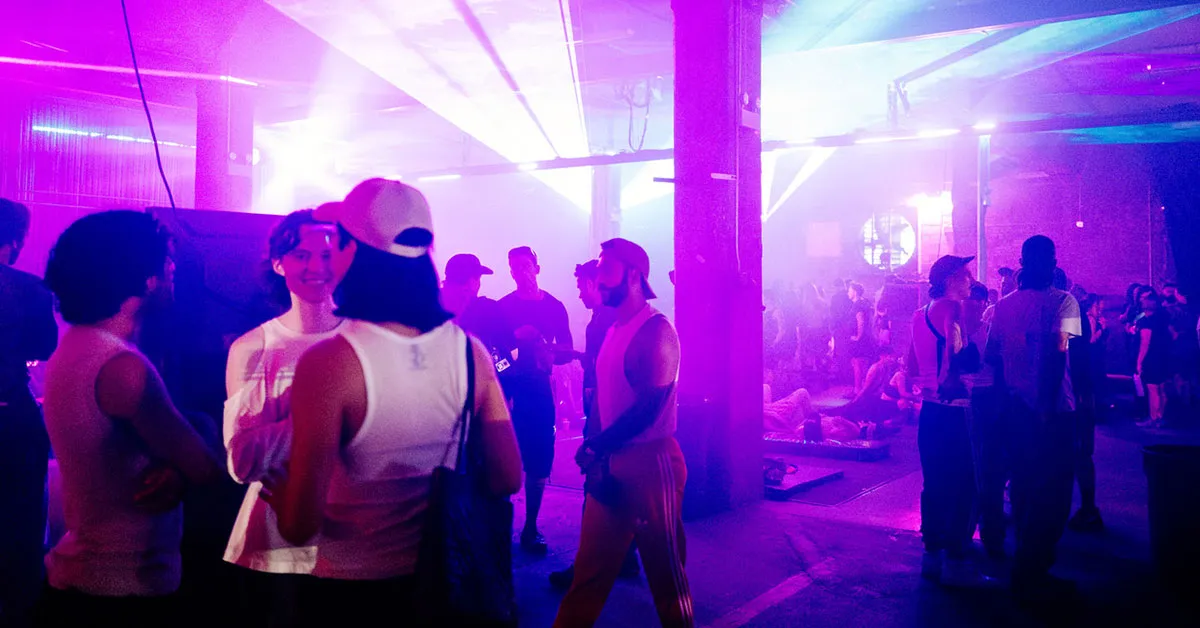
The Queer Nightlife Community Center in East New York, Brooklyn is partly an event space, partly a place of mutual aid and information-sharing, and partly a site of work-based training—all focused on trans and queer workers from the nightlife industry. In less than a year, they’ve programmed everything from dance performances to discussions about sexual violence prevention to tutorials on how to do your taxes as a gig worker.
I recently attended a fantastic event there: a listening session of the Stonewall Jukebox Project, an all-vinyl set curated by Honey Dijon and Chris Cruse replicating the jukebox at the Stonewall Inn. Afterwards, I sat down with Michael Falco, the executive director of the QNCC, to talk about the organization’s mission.
This is an excerpt from Pre Shift, our newsletter for the hospitality industry. Subscribe for more stories like this.
Al Culliton: How did the Queer Nightlife Community Center come to be?
Michael Falco: This project and its idea stretches back to like 2016 or 2017, when the mayor’s Office of Nightlife was formed in New York. Ariel Palitz [the director of that office] was doing a listening tour when the department launched. And one of our co-founders, Seva Granik, was on these listening tours and at some point said something to the effect of, well, what about the underground spaces? They were so focused on bars and more traditional nightlife spaces that there hadn’t been much conversation about the underground. So eventually the city took this request seriously and started to do a study of what it would look like to give over a city building to a kind of durational cultural space. [They looked to] Berlin, Milan, London, to see how, in those instances, those cities have handed over buildings to produce nightlife-type programming and cultural spaces.
So this study came out in 2019, and then the pandemic happened, and the Office of Nightlife shifted to small business services. The focus shifted [toward figuring out] how to save nightlife in general; bars were really struggling in the aftermath of the pandemic. The idea kind of got mothballed and went away for a while. Meanwhile, I had been [the founding Executive Director of an institute called INCITE] at Columbia University for 15 years, and around [2019-2021], had started to support more experimental programming and had started doing a party with Pornceptual. I eventually had Seva as a panelist at one of the talks. Afterwards, I asked him, “What’s an idea that you had been working on that never happened?” And he mentioned the city idea that had had all this momentum and traction but dissolved, as so much did during the pandemic.
So Seva and I began to think: Okay, well what would that look like? [We decided] it’s a community center; it’s a nonprofit. Along the way, this person Breakfast [Garbowski], who’s one of our co-founders, had been producing sets for some of the events Seva was doing [and] got in on the idea. We met this fundraiser, Kyle Dacuyan, who helped us strategize how to move from a concept to actually getting money for it. We formed the nonprofit in January 2025 with the idea that maybe we’d be in a building eventually. Before we knew it, we had leased a building for five years in East New York with a lease that started in September, and we began programming in October.
How does QNCC operate?
Our model is: How do we create the infrastructure that other arts organizations [like those involved in visual, performing, or theater arts] have? How do we build those nonprofit, donor-based guardrails around a nightlife object and a community of workers who make nightlife happen? [The goal of the project is to] redistribute institutional resources to nightlife.
What’s the state of nightlife, specifically the type you’re talking about that is more underground? What are the biggest challenges to the people working in that sector right now?
If you talk to anybody in this sector who’s producing events and programming clubs, they would say New York—although this is hubris—is as hot as it’s ever been. There is so much happening in club and underground life. Every weekend there are dozens of things that people can choose to go to. There’s a really vibrant scene in New York right now that is kind of unparalleled and in many ways competitive with places like Berlin [based on] the volume of things happening and the quality of the programming that’s happening.
At the same time, I think the economic pressures are intense. Doing something underground was easier 20 or 30 years ago. The real estate is so expensive that the baseline of even doing a program [is that] you have to make often $10,000, $12,000 just to break even on rent, without including lights and the sound system and DJs and staff and door people and things like that. The economic model is challenged. [There are] the same pressures that I think a lot of the industry are experiencing with regard to reliance on liquor sales, [which] are drying up.
[Underground nightlife today] requires much more expensive ticket prices, and the people you want to be experiencing this can’t afford expensive tickets in the first place. I don’t know many people who are producing, in particular, programs in non-traditional locations like warehouse rentals that are making money off of these things.
One of the challenges is like, how do you make this more sustainable? The hours are upside down. The work is often [offered as] independent contractor [work, rather than full-time]. [There’s also] the grind, the need to probably supplement your income with other labor. So our objective really has been to figure out how to introduce things into the nightlife economy that make it more feasible for people to do this work. Sometimes that’s just education. If you have a sense of how to get insurance or you have a better sense about how to handle your finances, or you have basic access to certain healthcare things that you might not otherwise access, it just makes doing this work a little bit easier.
An event at the QNCC. | Credit: Felipe Santiago
To your point about the model being broken, how does this time of transition and wealth disparity affect who is able to get their concepts out there? Has this had any kind of flattening effect on the level of artistry that you’re seeing?
There’s a lot of that programming and things happening around the city still. The underground has always been a response to what you’re talking about, those economic realities that price people out of producing things. So they find other ways to produce things. At the most fundamental DIY level, there are still people finding ways to do things with a scarcity of resources that would still blow your mind.
Our space is very much a response to [the economic barriers to entry]. In part, we formed this organization because we had no interest in having investors. We had no interest in trying to figure out how to squeeze, you know, twice, let alone ten times the [profit] out of a thing. That [type of nightlife] itself is just not designed, as far as I can tell, with those kinds of margins.
The QNCC specifically centers nightlife workers. What do people misunderstand about that work?
The people that are making [the underground scene] happen are poor, are often Black, are often trans, are often maybe treating nightlife as an opportunity to get work so that they can pursue what they care about, whether that’s arts or just making it in the city or being in New York. [Careers in nightlife] are not viewed as a destination; they’re [viewed as] jobs on the way to something else or somewhere else.
The labor that makes and comprises New York’s nightlife is deeply precarious. It’s a calling, actually, to bring people into space together and elevate someone’s understanding of themselves or the world or their connection or relationship to each other or themselves; it’s an incredibly powerful thing. It’s like a high expertise trade. [We’re trying to solve the question of:] how do you validate these skilled trades? How do we create education or work-based training programs that begin to take these really seriously as careers?
Part of that is changing the discourse around what it means to work in nightlife. We have allowed it to be trivialized because it’s fun, because it’s social, because it’s occurring in off hours and because sometimes it’s surrounded by substances or drinking. But it is community-building. It is organizing. It is healthcare. It is wellbeing. It is belonging.
“It’s a calling, actually, to bring people into space together and elevate someone’s understanding of themselves or the world or their connection or relationship to each other or themselves; it’s an incredibly powerful thing.”
Do you have any favorite moments since you opened the doors?
When I think about real underground events, what people are doing is basically creating a club for a night, right? [There’s] a particular energy that goes into that space and then it dissipates because you close it; you tear everything out and it’s over. [But] the first few times, when we would produce something [at QNCC, instead of dissipating, that energy] would linger.
We did an event called Slambient that was meant to be a more ambient, lighter event that allowed everyone, audience and workers alike, to have a slow, easeful end to the weekend. Coupled with that, we also were able to do a yoga day with free acupuncture, and we sold 75 tickets, all free for nightlife workers, while it was $10 for everyone else. It was just exciting to see that a space that could hold a party could also hold these other moments that are so different. Getting to experience the versatility and see what it means to generate energy in the space—then couple it with care that lingers and sticks around a little longer.
This interview has been edited and condensed.
Get our freshest features and recipes weekly.