

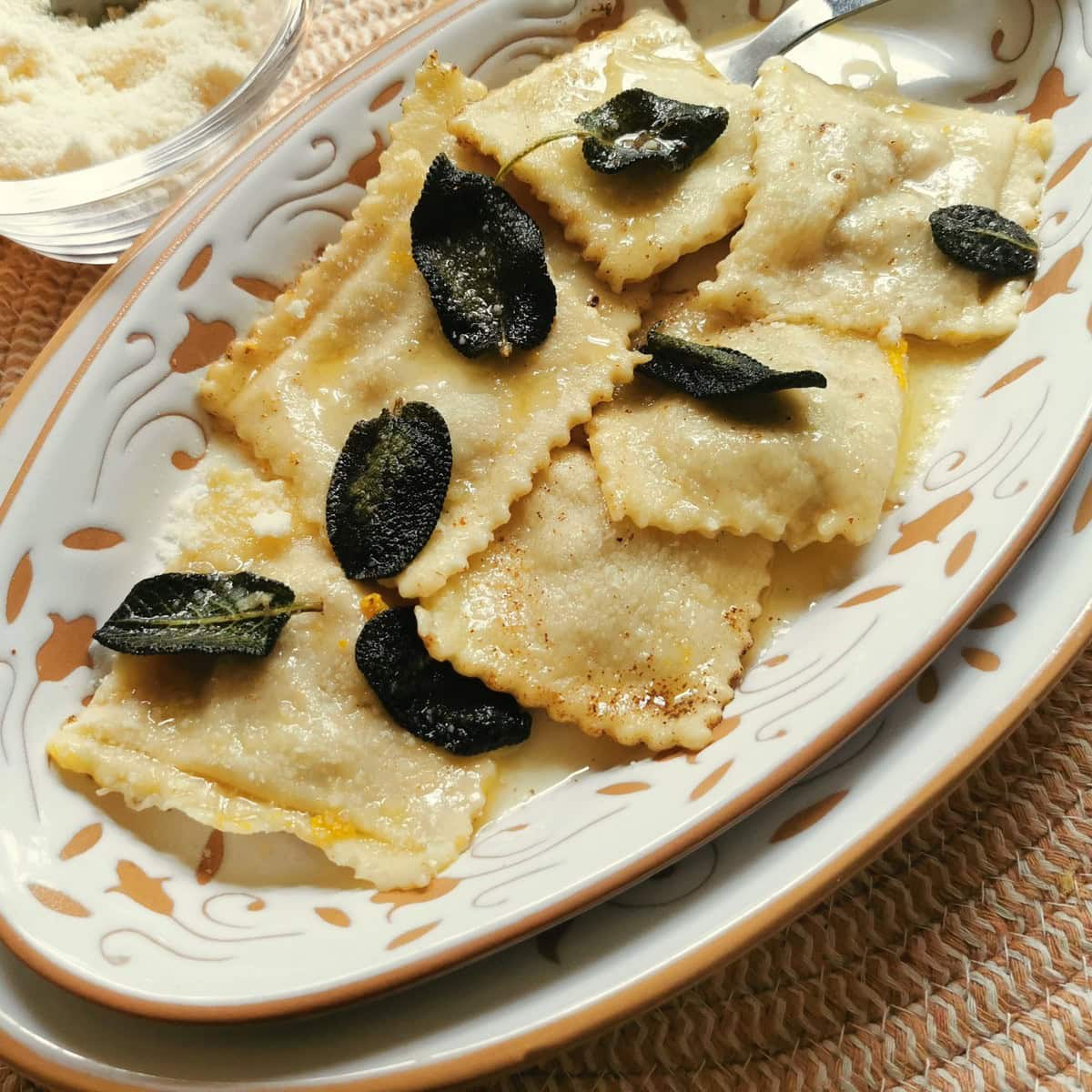
Seasoned with butter and sage and made with amaretti bicuits in the filling, these traditional Italian pumpkin tortelli are a divine historical stuffed pasta from Mantova in Northern Italy. Known as tortelli di zucca alla Mantovana, these pumpkin ravioli are a traditional Christmas Eve dish here in Northern Italy.
Tradition and origin.
Pumpkin tortelli actually date back to the Renaissance, when pumpkins first arrived in Italy from Central America. Rich stuffed pastas were very popular among the ruling classes and nobility at the time. In fact, the first written mention of pumpkin tortelli was in 1544 by Cristoforo Messisbugo, a Ferrarese cook who worked for the ruling Gonzaga family in Mantova. He refers to them in his recipe book as ‘turtell’ or ‘riturtell’.
A traditional Christmas dish.
However, pumpkin tortelli also became popular with the peasant population because pumpkins were actually considered humble food. Plus, stuffed pasta dishes were a nutritious and economical way to use up leftover pasta or othher ingredients. Eventually pumpkin tortelli became a traditional Christmas Eve dish in the towns and areas where it is most eaten.
This is probably because these tortelli are made without meat and, as I have mentioned in other recipe posts, Christmas Eve is a religious day of fasting and abstinence in many Italian homes. Italians call these days giorni di magro (meaning lean days) and the dishes themselves ‘piatti di magro’ (meaning lean plates).
Different versions of pumpkin tortelli.
Slightly different versions of pumpkin tortelli are made in many towns and provinces in Lombardy and Emilia-Romagna. In some places, they also serve them with tomato sauce. However, this recipe is based on what many feel is the most famous type of pumpkin tortelli, that from Mantova.
This version of pumpkin tortelli
Having said that, I should mention that one traditional ingredient in this version of Italian pumpkin tortelli isn’t easy to find, even in Italy. I’m talking about Mostarda di Mantova, a local condiment made with quince or apples and mustard essence that Northern Italians often eat with cheese or boiled meats. I don’t always use it. Instead, I add a little lemon zest.
Ingredients. Tips and substitutions
Filling ingredients.
Pumpkin: Choose a dense, sweet pumpkin for the filling. Delica is the variety most often used around Mantova but butternut squash works well too. Watery pumpkins make a filling that’s too soft to hold its shape, so if yours seems wet, roast it a little longer to let moisture evaporate rather than steaming or boiling it.
Eggs: I used 2 large free range eggs. If you only have smaller eggs, you may need 3.
Amaretti cookies (or biscuits): Amaretti cookies are traditional, naturally gluten-free Italian almond biscuits made from ground almonds or almond flour, apricot or peach kernels, sugar, and whipped egg whites. You can omit the amaretti if you prefer or replace them with ricotta (as is done in some areas in Italy), or use digestive biscuits or breadcrumbs.
Grana or Parmigiano: Neither of these cheeses are vegetarian as they contain animal rennet. To make your pumpkin ravioli vegetarian, use a vegetarian parmesan cheese. Alternatively, breadcrumbs, boiled potato or almond flour. These will help to absorb the liquid from the pumpkin and balance the sweetness of the pumpkin and amaretti.
Nutmeg: Although nutmeg isn’t cultivated in Italy, it’s been used in Italian cuisine since the Middle Ages. Nutmeg has a warm sweet-savory flavor and is popular in filled pasta. If you don’t have nutmeg, you can use mace which comes from the same seed as nutmeg or allspice. Alternatively, cinnamon powder can be used instead but use less as it’s more pungent than nutmeg.
Ingredients for the pasta dough.
The dough for pumpkin tortelli from Mantova is a classic egg pasta dough. It contains just eggs, Italian 00 flour and a pinch of salt.
The flour: Italian 00 flour (farina tipo 00 or “doppio zero”) is the most finely ground and refined soft wheat flour in the Italian classification system. It has a texture as soft and smooth as baby powder. It is traditionally used to make different types of egg pasta including lasagne, tagliatelle and many types of filled pasta. The best substitute for Italian ’00’ flour is All-Purpose flour.
Step by step instructions.
Make the filling.
Grind the amaretti biscuits in a food processor or crumble them finely using your hands. If using, chop the mostarda as finely as possible.
Cut the pumpkin into large slices, remove the seeds and cook it in the oven at 200° for about 20 minutes. Cooking time will vary depending on the size of your pumpkin pieces and your oven. You need it to be soft and slightly browned on the outside.
You can also steam the pumpkin but the original method is ‘baked’and the taste will be slightly less sweet. Remove the peel from the baked pumpkin pieces and place the pulp in a bowl, puree it with a fork or hand held blender. It needs to be a little rough, not too smooth.
Add the grated cheese, the crumbled amaretti, the chopped mostarda (if you have it), the eggs, a little grated nutmeg, the zest of one lemon (if no mostarda) and a little salt. Mix the ingredients well until you have a homogeneous mixture. Cover the bowl and let it rest for 24 hours or overnight in the fridge or a cool place.
Make the pasta dough.
1) Sift the flour into a large bowl, make a well in the middle, then add in the eggs. (you can do this first part in a stand mixer).
2) Use a fork to incorporate the flour with the eggs until the mixture is relatively dry.
3) Then knead with your hands until you can form a ball without the dough sticking to the sides of the bowl.
4) Then turn the dough out onto a pastry board and finish kneading by hand. Mix and knead the dough by hand until it’s soft and smooth. If it is too sticky (it may depend on the degree of absorption of the flour) add a little more flour. If, on the other hand, the dough is dry, you can moisten it by adding a little water at room temperature. However, it’s advisable to respect the egg to flour ratio to obtain a perfect egg pasta.
Roll the dough into a ball and wrap it in transparent film. Let it rest at room temperature in a cool place for at least 30 minutes.
Make the pumpkin tortelli.
Take the dough and divide it into about 4 parts (as you work it, leave the rest covered with cling film so it won’t dry out). Use a rolling pin or pasta machine to make rectangles that are about 1 mm thick.
1) Place the ready rolled out dough rectangle on a lightly floured work surface, cut it with a pastry cutter to make a strip about 9-10 cm wide. Place some teaspoons of filling along the upper part of the strip (leaving at least 1 cm from the edge) and 2-3 centimeters from each other.
2) Brush the edges of the dough with water and then fold the strip of fresh pasta over to cover the filling.
3) Press between the spaces of the small pieces of filling to remove any air and prevent the dough from separating.
4) Then cut out the tortelli with a serrated pastry wheel. The shape and size of the tortelli can vary according to taste and traditions. We made them square.
Repeat with the other pieces of dough. As you make the tortelli, place them on a tray lined with lightly floured dry paper or kitchen cloth. Continue until you finish the fresh pasta and the stuffing.
Finish and serve.
Put a large pot of water on to boil for the pasta. Add salt once it starts to boil and bring to the boil again.
While the water is boiling, melt the butter in a small frying pan or skillet. Add the fresh sage leaves and cook until they start to crisp. Remove from the heat.
Cook the tortelli in the boiling water until they rise to the surface. Should be about 4-5 minutes depending on the size and amount of filling. (remove and try one if they don’t seem to rise).
Remove the tortelli from the water with a slotted spoon and add to the pan with the sage butter. Mix a little so the tortelli are coated in the butter and then plate with a sprinkling of grated cheese. Serve immediately.
How to freeze your tortelli for later
Once you have made them, you can freeze these pumpkin tortelli uncooked. Spread them on a try in the freezer first and when they are frozen, transfer them to a freezer bag. You can cook them from frozen. But, better a few at a time, otherwise the water temperature will drop.
Serving Suggestions
Butter and sage is the classic way to dress these pumpkin tortelli from Mantova, and honestly I don’t think it needs much more than that. But if you want to vary things a little, here are some serving ideas I’ve tried over the years.
A brown butter sauce, where you let the butter cook just a little longer until it turns golden and smells nutty, adds an extra layer of flavour that pairs beautifully with the sweetness of the pumpkin filling. Just watch it closely since it can go from golden to burnt quite quickly.
For a simpler finish, toss the cooked tortelli with melted butter and a generous amount of grated Parmigiano Reggiano or Grana Padano, skipping the sage altogether. This works well if you want the pumpkin and amaretti flavours to really shine through.
Some cooks in the area also serve pumpkin tortelli with a light sausage ragù instead of butter and sage, especially outside of the Christmas Eve tradition when the lean dish rule doesn’t apply. It’s richer and makes a heartier main course rather than a delicate primo.
As mentioned above, a mild tomato sauce is another option you’ll find in some towns, though I’d keep it quite light so it doesn’t overpower the delicate sweet and savoury balance of the filling.
Whichever way you dress them, serve pumpkin tortelli as soon as they’re plated. They’re best enjoyed hot, straight from the pan, while the butter is still glossy and the sage still fragrant.
Let me know what you think.
This is a great recipe for a festive menu during holidays like Christmas and Thanksgiving. Italians serve these pumpkin tortelli from Mantova as a primo (first course) before the main course. Why not add an Italian touch to your next holiday menu and include this divine dish?
If you make this pumpkin tortelli recipe, I’d love to hear how it turns out. Please write a comment here on the blog or post a comment on the Pasta Project Facebook page.
Your feedback means a lot to me!
Buon Appetito!
Save this recipe for later?
If you want to save this recipe for later, you can print it, bookmark this page or save it to Pinterest. Or, make your own online recipe box by clicking the ❤️ in the lower right corner of your screen & following the quick and easy instructions!If you want to save this recipe for later, you can print it, bookmark this page or save it to Pinterest.
Pumpkin Tortelli with Amaretti biscuits from Mantova.
These divine tortelli from Mantova in Northern Italy are filled with roasted pumpkin, crushed amaretti biscuits, eggs, cheese and nutmeg. They are traditionally served on Christmas Eve dressed in a sage butter but would make a delicious addition to any festive menu.
]]>]]>
Prep Time 1 hour
Cook Time 30 minutes
Dough resting time 30 minutes
Total Time 2 hours
Course Homemade Pasta, Main Course
Cuisine Italian, Lombardy, Northern Italy
Servings 4
Calories 879 kcal
Ingredients
US CustomaryMetric
1x2x3x
For the pasta
- 14 ounces Italian ’00’ flour You can also use all purpose flour to make the pasta dough
- 4 eggs
- 1 pinch salt
For the filling
- 2.2 pounds pumpkin Italians use pumpkins from Mantova like Delica. Try to use a pumpkin with bright orange slightly sweet flesh.
- 2 eggs
- 3.5 ounces Grana Padano or Parmigiano Reggiano (3.5 oz) grated Strict vegetarians should use a vegetarian cheese.
- 3.5 ounces Amaretti biscuits (3.5 oz) crushed
- 1 lemon for zest
- ½ teaspoon nutmeg freshly grated
- salt to taste
- 3 tablespoon Mostarda Mantovana optional but leave out lemon zest if you use mostarda
For the dressing
- 3 ounces butter
- 6-8 sage leaves
- grana or parmigiano as required
Instructions
Make the filling
-
Grind the amaretti biscuits in a food processor or crumble them finely using your hands. If using, chop the mostarda as finely as possible.
-
Cut the pumpkin into large slices, remove the seeds and cook it in the oven at 200° for about 20 minutes. Cooking time will vary depending on the size of your pumpkin pieces and your oven. You need it to be soft and slightly browned on the outside.
-
You can also steam the pumpkin but the original method is ‘baked’and the taste will be slightly less sweet. Remove the peel from the baked pumpkin pieces and place the pulp in a bowl, puree it with a fork or hand held blender. It needs to be a little rough, not too smooth.
-
Add the grated cheese, the crumbled amaretti, the chopped mostarda (if you have it), the eggs, a little grated nutmeg, the zest of one lemon (if no mostarda) and a little salt. Mix the ingredients well until you have a homogeneous mixture. Cover the bowl and let it rest for 24 hours or overnight in the fridge or a cool place.
Make the pasta
-
Sift the flour into a bowl, make a well in the middle, then add in the eggs. Use a fork to incorporate the eggs with the flour.
-
Mix and knead the ingredients by hand until you obtain a soft and non-sticky mixture that doesn’t stick to the sides of the bowl. If it is too sticky (it may depend on the degree of absorption of the flour) add a little more flour. If, on the other hand, the dough is dry, you can moisten it by adding a little water at room temperature.
-
However, it’s advisable to respect the egg to flour ratio to obtain a perfect egg pasta.
-
Turn the dough out onto a flour dusted pastry board and continue kneading until it’s soft. smooth and pliable.
-
Roll the dough into a ball and wrap it in transparent film. Let it rest at room temperature in a cool place for at least 30 minutes. Then take the dough and divide it into about 4 parts (as you work it, leave the rest covered with cling film so it won’t dry out). Use a rolling pin or pasta machine to roll out rectangles that are about 1 mm thick.
-
Place the ready rolled out dough rectangle on a lightly floured work surface, cut it with a pastry cutter to make a strip about 9-10 cm wide. Place some teaspoons of filling along the upper part of the strip (leaving at least 1 cm from the edge) and 2-3 centimeters from each other.
-
Brush the edges of the pasta sheet with water and then fold the strip of fresh pasta over to cover the filling.
-
Press between the spaces of the small pieces of filling to remove any air and prevent the dough from separating. Then cut out the tortelli with a serrated pastry wheel. The shape and size of the tortelli can vary according to taste and traditions. I made them square like ravioli.
-
Repeat with the other pieces of dough. As you make the tortelli, place them on a tray lined with lightly floured kitchen paper or kitchen cloth. Continue until you finish the fresh pasta and the stuffing.
Finish the dish
-
Put a pot of water on to boil for the pasta. Add salt once it starts to boil and bring to the boil again.
-
While the water is boiling, melt the butter in a frying pan or skillet. Add the sage leaves and cook until they start to crisp. Remove from the heat.
-
Cook the tortelli in the boiling water until they rise to the surface. Should be about 4-5 minutes depending on the size and amount of filling. (remove and try one if they don’t seem to rise.
-
Remove the tortelli from the water with a slotted spoon and add to the pan with the sage butter. Mix a little so the tortelli are coated in the butter and then plate with a sprinkling of grated cheese. Serve immediately.
Cook ModePrevent your screen from going dark
Notes
If you use the Mostarda Mantovana, you can leave out the lemon zest.
If you don’t have Mostarda Mantovana and want a little more depth than lemon zest alone gives, a few finely chopped candied fruits with a tiny drop of mustard essence can stand in reasonably well.
Use just a teaspoon of filling per tortello. Overfilling is the most common reason they burst open in the boiling water, since the extra pressure pushes against the seams as the pasta cooks.
Recipe times don’t include leaving the filling in the fridge overnight.
Pumpkin tortelli can be frozen uncooked. Spread them on a tray in the freezer first and once they are frozen, you can transfer them to a freezer bag. You can cook them from frozen. But, better a few at a time, otherwise the water temperature will drop.
Strict vegetarians should use a vegetarian cheese not made with animal rennet.
Nutrition
Calories: 879kcalCarbohydrates: 118gProtein: 33gFat: 32gSaturated Fat: 17gPolyunsaturated Fat: 2gMonounsaturated Fat: 9gTrans Fat: 1gCholesterol: 306mgSodium: 708mgPotassium: 1114mgFiber: 6gSugar: 27gVitamin A: 22340IUVitamin C: 37mgCalcium: 413mgIron: 8mg
Keyword amaretti, pumpkin, ravioli, tortelli